




Ramadan
This Ramadan Guide will explain what Ramadan is, how to fast in Ramadan, who can fast, who is exempt from fasting, medical and health advice and all the rules of fasting and what other things to to do and not to do in Ramadan
The Month of Ramadan
The month of Ramadan is a great month. It is the month in which Allah revealed the Quran as a guidance for the whole of mankind. It is the month in which Allah gave the Muslims victory in their first and greatest battle at Badr. It is the month which has Laylat al-Qadr, a night which is better than a thousand months.
In Ramadan the gates of heaven are opened and the gates of Hell are shut, and the shayaateen (devils) are tied up and the reward for good deeds, acts of charity and acts of worship are multiplied in this month.
Ibn Khuzaymah (1986) and Ibn Hibbaan (7491) narrated that Abu Umaamah al-Baahili
(may Allaah be pleased with him) said: I heard the Messenger of Allaah
(peace and blessings of Allaah be upon him) say: “Whilst I was sleeping, two
men came to me and took hold of my upper arm, and brought me to a rugged
mountain. They said: ‘Climb up.’ I said: ‘I cannot do it.’ They said: ‘We
will make it easy for you.’ So I climbed up until I was at the top of the
mountain. There I heard loud voices. I said: ‘What are these voices?’ They
said: ‘This is the screaming of the people of Hell.’ Then I was taken and I
saw people suspended by their ankles, with the corners of their mouths torn
and pouring with blood. I said: ‘Who are these?’ They said: ‘These are the
people who broke their fast before it was time to do so.’” Classed as saheeh
by al-Albaani in Saheeh Mawaarid al-Zam’aan, 1509.
Allah says
"The month of Ramadan in which was revealed the Quran, a guidance for
mankind and clear proofs for the guidance and the criterion (between right
and wrong). So whoever of you sights (the crescent on the first night of)
the month (of Ramadan i.e. is present at his home), he must observe Sawm
(fasts) that month, and whoever is ill or on a journey, the same number [of
days which one did not observe Sawm (fasts) must be made up] from other
days. Allaah intends for you ease, and He does not want to make things
difficult for you. (He wants that you) must complete the same number (of
days), and that you must magnify Allaah [i.e. to say Takbeer (Allaahu Akbar:
Allaah is the Most Great)] for having guided you so that you may be grateful
to Him”
[al-Baqarah 2:185]
It was narrated that Abu Hurayrah (may Allaah be pleased with him) said: The
Prophet (peace and blessings of Allaah be upon him) ascended the minbar and
said: “Ameen, ameen, ameen.” It was said: ‘O Messenger of Allaah, you
ascended the minbar and said, ‘Ameen, ameen, ameen.” He said: “Jibreel
(peace be upon him) came to me and said: ‘If Ramadaan comes and a person is
not forgiven, he will enter Hell and Allaah will cast him far away. Say
Ameen.’ So I said Ameen. He said: ‘O Muhammad, if both or one of a person’s
parents are alive and he does not honour them and he dies, he will enter
Hell and Allaah will cast him far away. Say Ameen.’ So I said Ameen. He
said: ‘If you are mentioned in a person’s presence and he does not send
blessings upon you and he dies, he will enter Hell and Allaah will cast him
far away. Say Ameen.’ So I said Ameen.”
Narrated by Ibn Hibbaan, 3/188; classed as saheeh by al-Shaykh al-Albaani in
Saheeh al-Targheeb, 1679
Fasting In Ramadan
Allah has made fasting the month of Ramadan obligatory upon every adult, sane, settled (i.e., not travelling) Muslim who is able to fast and has nothing such as hayd [menstruation] or nifaas [postnatal bleeding] to prevent him or her from doing so.
Ibn Umar (may Allaah be pleased with him) said: The Messenger of Allaah (peace and blessings of Allaah be upon him) said: “Islam is built on five (pillars): the testimony that there is no god but Allaah and Muhammad is the Messenger of Allaah; establishing prayer; paying zakaah; Hajj; and fasting Ramadaan.” (Al-Bukhaari and Muslim)
- What to do if you are ill or fall ill or if you suffer from a medical condition
- What to do if you are elderly
- What to do if you are travelling
- Ruling of fasting whilst doing Jihad
- Rulings on fasting for women (menstruation etc)
- Do pregnant and Breast feeding women fast ?
- SOME HEALTH GUIDELINES FOR RAMADAN
Definition of Fasting
Fasting means abstaining from several things, from just before the starting of dawn (i.e. just before the start of Fajr) until sunset, with the intention of fasting.
A Muslim fasting must abstain from the following
- Food and Drink
- Sexual intercourse
- masturbation (most scholars say this not allowed even when not fasting)
- deliberately causing one's self to vomit
If these four things listed above are done deliberately a persons fast will be broken.
Who Must Fast?
Allah has made fasting the month of Ramadan obligatory upon every adult, sane, settled (i.e., not travelling) Muslim who is able to fast and has nothing (such as hayd [menstruation] or nifaas [postnatal bleeding] ) to prevent him or her from doing so.
- What to do if you are ill or fall ill or if you suffer from a medical condition
- What to do if you are elderly
- What to do if you are travelling
- Ruling of fasting whilst doing Jihad
- Rulings on fasting for women (menstruation etc)
- Do pregnant and Breast feeding women fast ?
- SOME HEALTH GUIDELINES FOR RAMADAN
Why Do Muslims Fast In Ramadan?
Fasting has been enjoined on us so that we may become pious. A pious Muslim and Muslimah does whatever Allah and His Messenger have told them to do. Allah says (interpretation of the meaning):
"O you who believe! Observing As-Sawm (the fasting) is prescribed for you as it was prescribed for those before you, that you may become Al-Muttaqoon (the pious)? [al-Baqarah 2:183]
And Allah says in a hadeeth qudsi:
Fasting is for Me and I will reward for it. He gives up his desire and his food and drink for My sake." Narrated by al-Bukhaari, 7492; Muslim, 1151.
The purpose of fasting is not to just get hungry and thirsty but it is to develop Taqwa ( piety).
Prophet (peace and blessings of Allaah be upon him) said: “Fasting is not just (abstention) from food and drink, rather fasting is (abstention) from idle and obscene talk.” Narrated by al-Haakim and classed as saheeh by al-Albaani in Saheeh al-Jaami’ (5376).
Prophet (peace and blessings of Allah be upon him) said: "Whoever does not give up false speech and false actions and ignorance, Allah has no need of his giving up his food and drink." Narrated by al-Bukhaari, 6057.
It was narrated that Abu Hurayrah (may Allaah be pleased with him) said: The Messenger of Allaah (peace and blessings of Allaah be upon him) said: “There may be people who fast and get nothing from their fast except hunger, and there may be those who pray qiyaam and get nothing from their qiyaam but a sleepless night.”
Narrated by Ibn Maajah, 1690; classed as saheeh by Ibn Hibbaan, 8/257, and by al-Albaani in Saheeh al-Targheeb, 10/83. (similar hadith narrated by Ibn umar in al-Tabaraani in al-Kabeer, 12/382; classed as saheeh by al-Albaani in Saheeh al-Targheeb wa’l-Tarheeb, 1084.
So one should stay away from Un-Islamic things such as:
- Getting angry
- Using Bad language
- Back biting and gossip
- Arguing and fighting with Muslims.
- Promoting Un-Islamic ideologies such as democracy and socialism.
- Being rude and impolite
- Looking, touching , flirting with non-mehrems of the opposite sex.
- Lying and cheating
- Engaging in riba (interest, usury)
- Women wearing improper dress.
- Men shaving beards and having cloths below ankles
- Allying with the enemies of Islam against the Muslims
- Anything that is Haram
The reward for fasting is immense, as mentioned in the following Hadeeth
"Every action of the son of Adam is given manifold reward, each good deed receiving then times its like, up to seven hundred times. Allah the Most High said, 'Except for fasting, for it is for Me and I will give recompense for it, he leaves off his desires and his food for Me.' for the fasting person there are two times of joy; a time when he breaks his fast and a time of joy when he meets his Lord, and the smell coming from the mouth of the fasting person is better with Allah than the smell of musk." [al-Bukhari]
Also, Sahl ibn Sa`d said that the Prophet (peace be upon him.) said: "Indeed there is a gate of Paradise called ar-Rayyaan. On the day of Resurrection those who fast will enter through it; no one enters it except for them, and when they have entered, it is closed so that no one enters it, so when the last of them enters it, it is closed, and whoever enters it drinks, and whoever drinks never becomes thirsty." [Ibn Khuzaimah, Saheeh].
Fasting is a shield against the Fire:
"Fasting is a shield with which a servant protects himself from the Fire." [Ahmad, Saheeh]
On the Day of Judgment, "Fasting will say: O My Lord I prevented him from food and desires so accept my intercession for him." [Ahmad, al-Haakim and Abu Nu'aim, Hasan]
Fasting is a means to attain forgiveness for one's sins.
The Prophet (peace be upon him.) said: "He who fasts Ramadan, due to eemaan and hoping for reward (from Allah) then his past sins are forgiven."[al-Bukhari, Muslim]
- The supplication of the fasting person is answered:
There are in the month of Ramadan in every day and night those to whom Allah grants freedom from the Fire, and there is for every Muslim a supplication which he can make and will be granted." [al-Bazzaar, Ahmad, Saheeh]
Umar ibn al-Khattaab and Ali ibn Abi Taalib (may Allah be pleased with them) said: Fasting does not just mean giving up food and drink; it also means giving up lies, falsehood and idle talk
Jaabir ibn Abd-Allaah said: If you fast, then block your ears, eyes and tongue from lies and sin; do not abuse your servants; be tranquil and dignified on the day of your fast; do not let the day when you do not fast and the day when you fast be the same.
It was narrated that Taleeq ibn Qays said: Abu Dharr said: When you fast then be careful as much as you can. When Taleeq was fasting he would enter his house and only come out to pray
When Abu Hurayrah and his companions (may Allah be pleased with them) fasted, they would stay in the mosque and say, "We are keeping our fast pure."
If you have a medical problem and are worried about fasting please click here...
SOME HEALTH GUIDELINES FOR RAMADAN
How to Fast and rulings regarding fasting
1 The Intention
It is obligatory for the fasting person to confirm his/her intention before the appearance of fajr.
The Prophet (peace be upon him) said "He who does not resolve to fast before it is fajr, then there is no fast for him"(Abu Dawood)
Prophet (peace and blessings of Allah be upon him) said: "Whoever does not intend to fast before dawn, there is no fast for him." Narrated by al-Tirmidhi, 730. According to a version narrated by al-Nasaa'i (2334): "Whoever does not intend to fast from the night before, there is no fast for him." Classed as hasan by al-Albaani in Saheeh al-Tirmidhi, 573.
The place of intention is the heart and to utter it verbally is not established from the Prophet (peace be upon him) or his companions, may Allah be pleased with them. Thus one should make intention in ones heart before going to sleep.
2 The time for beginning and ending the fast.
i ) There are two types of fajr:
-False fajr and True fajr
a) False Fajr, At this time it is unlawful to pray fajr prayer but it is permissible to eat for the one intending to fast. The false fajr is distinguished by a rising vertical column of whiteness which appears like the tail of a wolf
b) True fajr. At this time it is lawful to pray the fajr pray but is it unlawful to eat for one who is fasting. It is distinguished by a white light coming across the horizon in the East ,
Thus one should stop all eating and drinking before the True fajr.
ii) The meal that is taken before the fajr is called Suhoor (pre-dawn meal)
We should make sure that we eat and drink something at Suhoor, and that we delay it until just before the adhaan of Fajr.
The Prophet (peace and blessings of Allah be upon him) said "The distinction between our fasting and the fasting of the people of the book is the taking of the pre -dawn meal (Suhoor)" (Muslim)
The Prophet (peace and blessings of Allah be upon him) said: " Have Suhoor, for in Suhoor there is blessing (barakah)." (Reported by al-Bukhaari, Fath, 4/139)
"Suhoor is blessed food, and it involves being different from the people of the Book. What a good Suhoor for the believer is dates." (Reported by Abu Dawood, no. 2345; Saheeh al-Targheeb, 1/448).
He (peace be upon him) also said "The Suhoor is a meal of blessings, so do not leave it, even if one of you takes just a gulp of water, since Allah sends mercy and His angels seek forgiveness for those who take Suhoor" (Ahmad)
It is also guidance of the Prophet (peace be upon him) to delay the Suhoor meal until just before the true fajr. (note along with no eating or drinking whilst fasting. one can not have sexual intercourse with spouse. kissing and hugging is allowed but if such close contact causes ejaculation then this will break the fast. Also swallowing some one elses saliva invalidates the fast.
3 The time to breaking the fast (Iftar).
This time is as soon as Maghrib Starts (after sun has set). If you are in the Masjid or close by and hear the Athan for Maghrib prayer then it means you can now break your fast.
One should hasten to break the fast because the (peace and blessings of Allah be upon him) said: "The people will be fine so long as they do not delay iftaar." (Reported by al-Bukhaari, Fath, 4/198). He (peace be upon him) also said "My Ummah will not cease to be upon my Sunnah as long as they do not await the stars when breaking the fast" (Ibn Hibban). So as soon as Maghrib begins (i.e. if you are in the Masjid and Athan is said) one should start to break the fast immediately.
Break the fast in the manner described in the hadeeth narrated by Anas (may Allah be pleased with him):
"The Prophet (peace and blessings of Allah be upon him) used to break his fast with fresh dates before praying; if fresh dates were not available, he would eat (dried) dates; if dried dates were not available, he would have a few sips of water." (Reported by al-Tirmidhi, 3/79 and others. He said it is a ghareeb hasan hadeeth. Classed as saheeh in al-Irwa?, no. 922).
Dua said when Breaking the fast
Following is dua to recited.
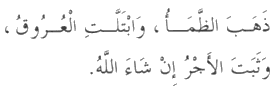
Thahaba th-thama o wabtallatil-Aaurooq, wathabatal ajru in shaal-lah
(The thirst has gone and the veins are quenched, and reward is confirmed, if Allah wills.)
Prophet's warning for those who break the fast before its time
Prophet (peace be upon him) said, “While I was sleeping, two men came
to me and took hold of my arms. They brought me to a steep mountain and
said, ‘Climb.’ I said, ‘I am not able to.’ They said, ‘We will make it easy
for you.’ So I climbed until I came to the summit of the mountain where I
heard terrible cries. I said, ‘What are these cries?’ They said, ‘Those are
the cries of the inhabitants of the Fire.’ Then they took me further until I
came to a people who were strung up by their hamstrings, and their jawbones
were torn and flowing with blood. I said, ‘Who are these people?’ He said,
‘Those are the people who break their fast before the time it was
permissible to do so.’”
Recorded by ibn Hibban and ibn Khuzaima.
According to al-Albani, it is sahih. Al-Albani,
Sahih al-Targheeb wa al-Tarheeb, vol. 1, p. 420.
There are certain things that break the fast and some things that do not break the fast
- Things that break the fast and things that do not break a persons fast
- Ruling on Swallowing ones own Saliva or wife's Saliva, kissing/hugging wife
If a person accidently eats, drinks or swallows anything it does not break his fast and they should continue fasting.
Abu Hurayrah (may Allaah be pleased with him) said: The Prophet (peace and blessings of Allaah be upon him) said: “Whoever forgets he is fasting and eats or drinks, let him complete his fast for it is Allaah Who has fed him and given him to drink.” ( Bukhari and Muslim)
If a person becomes ill during his fast or so thirsty or hungry that he could become severely ill or die then he is allowed to break the fast and make it up later. There is no sin on him.
However those who deliberately break their fast without any valid excuse they should remember the following hadith.
Abu Umaamah al-Baahili
(may Allaah be pleased with him) said: I heard the Messenger of Allaah
(peace and blessings of Allaah be upon him) say: “Whilst I was sleeping, two
men came to me and took hold of my upper arm, and brought me to a rugged
mountain. They said: ‘Climb up.’ I said: ‘I cannot do it.’ They said: ‘We
will make it easy for you.’ So I climbed up until I was at the top of the
mountain. There I heard loud voices. I said: ‘What are these voices?’ They
said: ‘This is the screaming of the people of Hell.’ Then I was taken and I
saw people suspended by their ankles, with the corners of their mouths torn
and pouring with blood. I said: ‘Who are these?’ They said: ‘These are the
people who broke their fast before it was time to do so.’” Narrated by Ibn Khuzaymah (1986) and Ibn Hibbaan
(7491) and classed as saheeh
by al-Albaani in Saheeh Mawaarid al-Zam’aan, 1509.
If a person breaks his fast without a valid excuse by eating or drinking then he should repent sincerely and make up that day after Ramadan but if he/she breaks their fast by having intercourse then he must offer kaffarah (expiation) by fasting two consecutive months or feeding 60 poor people.
It was narrated that Abu Hurayrah (may Allaah be pleased with him)
said: Whilst we were sitting with the Prophet (peace and blessings of Allaah
be upon him), a man came to him and said, “O Messenger of Allaah, I am
doomed!” He said, “What happened?” He said, “I had intercourse with my wife
when I was fasting [in Ramadan].” The Messenger of Allaah (peace and
blessings of Allaah be upon him) said, “Are you able to free a slave?” He
said, “No.” He said, “Are you able to fast for two consecutive months?” He
said, “No.” He said, “Can you feed sixty poor persons?” He said, “No.” Then
the Prophet (peace and blessings of Allaah be upon him) remained silent for
a while, and whilst we were like that, a large vessel of dates was brought
to the Prophet (peace and blessings of Allaah be upon him), and he said,
“Where is the one who was asking?” He said, “Here I am.” He said, “Take
these and give them in charity.” The man said, “Is there anyone more poor
than me, O Messenger of Allaah? For there is no household between the two
harrahs (lava fields – i.e., in Madeenah) that is poorer than my household.”
The Messenger of Allaah (peace and blessings of Allaah be upon him) smiled
until his eyeteeth could be seen, then he said, “Feed it to your family.”
(Narrated by al-Bukhaari, 1834, 1835; Muslim, 1111)
6a Special circumstances for all
- Ruling on Travellers fasting
- Do Sick have to fast?
- Do elderly have to fast ?
- Ruling of fasting whilst doing Jihad
6b Special circumstances for Women
7 Importance of repenting repenting from sins and seeking forgiveness from Allah for our sins
The Prophet (peace be upon him.) said: "He who fasts Ramadan, due to eemaan and hoping for reward (from Allah) then his past sins are forgiven."[al-Bukhari, Muslim]
The Angel Jibreel made Dua against the one who does not have his/her sins forgiven in the month of Ramadan and the Prophet (peace and blessings of Allaah be upon him) said Ameen, Ameen, Ameen to Angel Jibreels Dua as mentioned in the following hadith.
It was narrated from Abu Hurayrah that the Messenger of Allaah (peace and blessings of Allaah be upon him) ascended the minbar and said: “Ameen, Ameen, Ameen.” It was said to him, “O Messenger of Allaah, why did you do that?” He said, “Jibreel said to me, ‘May Allaah rub his nose in the dust, that person who Ramadaan comes and his sins are not forgiven,’ and I said, ‘Ameen’. Then he said, ‘May Allaah rub his nose in the dust, that person who lives to see his parents grow old, one or both of them, but he does not enter Paradise,’ and I said, ‘Ameen’. Then he said, ‘May Allaah rub his nose in the dust, that person in whose presence you are mentioned and he does not send blessings upon you,’ and I said, ‘Ameen.’” Narrated by Ibn Khuzaymah, 1888; al-Tirmidhi, 3545; Ahmad, 7444; Ibn Hibbaan, 908. See Saheeh al-Jaami’, 3501
Therefore it is vital for us to stay away from sin, repent sincerely and ask Allah to forgive us of our sins because for sure Allah will answer the dua of Angel Jibreel and his Prophet (peace and blessings of Allaah be upon him).
He be exalted, says (interpretation of the meaning):
“Say: O ‘Ibaadi (My slaves) who have transgressed against themselves (by
committing evil deeds and sins)! Despair not of the Mercy of Allaah, verily,
Allaah forgives all sins. Truly, He is Oft‑Forgiving, Most Merciful”
[al-Zumar 39:53].
It was narrated from Abu Moosa (may Allah be pleased with him) that the
Prophet (blessings and peace of Allah be upon him) said: “Allaah holds out
His hand at night to accept the repentance of those who have sinned during
the day, and He holds out his hand by day to accept the repentance of those
who have sinned at night – until the sun rises from its place of setting.”
Narrated by Muslim, 2759
It was reported that Aishah said: “I said, ‘O Messenger of Allaah, what do you think, if I witness Laylat al-Qadr, what should I say?’ He said: Say, Allaahumma innaka 'afuwwun tuhibb al-afwa fa'fu 'annii ( O Allaah, You are Forgiving and Generous, and you love forgiveness, so forgive me.) (Narrated by Imaam Ahmad, al-Tirmidhi (3515) and Ibn Maajah (3850). Its isnaad is saheeh).
8 Combining fasting with feeding the poor is one of the means of reaching Paradise
Prophet (peace and blessings of Allah be upon him) said: "In Paradise there are rooms whose outside can be seen from the inside and the inside can be seen from the outside. Allah has prepared them for those who feed the poor, who are gentle in speech, who fast regularly and who pray at night when people are asleep." (Reported by Ahmad 5/343; Ibn Khuzaymah, no. 2137. Al-Albaani said in his footnote, its isnaad is hasan because of other corroborating reports).
The Prophet (peace and blessings of Allah be upon him) said: "Whoever gives food to a fasting person with which to break his fast, will have a reward equal to his, without it detracting in the slightest from the reward of the fasting person." (Reported by al-Tirmidhi, 3/171; Saheeh al-Targheeb, 1/451). Shaykh al-Islam [Ibn Taymiyah] (may Allah have mercy on him) said: "What is meant is that he should feed him until he is satisfied."(Al-Ikhtiyaaraat al-Fiqhiyyah, p. 109).
It was narrated that Ibn Abbaas said: "The Messenger of Allah (peace and blessings of Allah be upon him) was the most generous of people, and he was at his most generous during Ramadan when Jibreel met him. He would meet him each night and revise the Quran with him. The Messenger of Allah (peace and blessings of Allah be upon him) was more generous than the blowing wind. " (Narrated by al-Bukhaari, 6; Muslim, 2308. )
9 Special Night Prayer during Ramadan( Taraweeh)
10 Importance of last 10 Nights of Ramadan
Abu Hurayrah (may Allah be pleased with him) that the Prophet (peace and blessings of Allah be upon him) said: “Whoever stays up and prays on Laylat al-Qadr out of faith and in the hope of reward, his previous sins will be forgiven.” (Agreed upon).
Whilst seeking Laylat al Qadr
Aishah said: “I said, ‘O Messenger of Allaah, if I know which night is Laylat al-Qadr, what should I say on that night?’ He said, ‘Say: Allaahumma innaka ‘afuwwun tuhibb al-‘afwa fa’affu ‘anni (O Allaah, You are forgiving and You love forgiveness, so forgive me).”(Narrated by Imam Ahmad, al-Tirmidhi (3515) and Ibn Maajah (3850). Its isnaad is saheeh).
11 Zakaat Al-Fitr
12 Eid Al Fitr
13 Fasting 6 days in the month after Ramadan(i.e Month of Shawwaal)
14 Optional fasts in other months of the year
It was narrated that al-Rubayyi’ bint Mu’awwidh said: On the
morning of ‘Ashoora’ the Prophet (peace and blessings of Allaah be upon him)
sent word to the villages of the Ansaar saying, “Whoever started out not
fasting, let him not eat for the rest of the day, and whoever started the
day fasting, let him fast.” She said: We used to fast and make our children
fast, [and take them to the mosques] and make toys for them out of wool,
then if one of them cried for food we would give him that toy until iftaar.
Narrated by al-Bukhaari, 1859; Muslim, 1136 – the words in square brackets
were narrated by Muslim.
Al-Nawawi said:
This hadeeth shows that we should train children to do acts of worship and
get them used to that, but they are not accountable. Al-Qaadi said: It was
narrated from ‘Urwah that when they are able to fast it becomes obligatory
upon them. This is a mistake which is disproven by the saheeh hadeeth, “The
Pen is lifted from three: from the child until he reaches adolescence…” And
Allaah knows best.
Sharh Muslim, 8/14
If after reading the information on the website you have any questions please email US
Please don't forget to make dua for me. JazakaAllah khair
MuslimConverts.com Web Admin